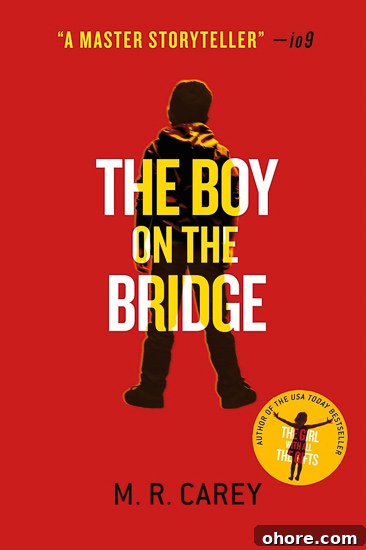
A review of The Boy on the Bridge by M. R. Carey.
This post contains affiliate links; full disclosure appears in the sidebar.
The Boy on the Bridge by M. R. Carey
I was a big fan of M. R. Carey’s The Girl with All the Gifts, so I eagerly picked up The Boy on the Bridge. Although technically a prequel set roughly twenty years before The Girl with All the Gifts, The Boy on the Bridge stands on its own and enriches the world Carey established. You can enjoy either novel independently, but reading both gives the fullest view of his bleak, compelling universe.
The story begins aboard Rosie, a rugged vehicle that serves as both mobile laboratory and armored transport as it travels from Beacon on England’s south coast to the Scottish Highlands. Rosie’s crew is divided into two distinct teams: a medical and scientific unit tasked with collecting tissue samples, and a military contingent charged with protecting the scientists from the hungries. In Carey’s world, the hungries are infected humans—zombies—whose numbers and ferocity shape every decision the survivors make.
What elevates this post-apocalyptic tale is the depth of character development and the tension that comes from contrasting perspectives. The scientific team and the military operate under very different assumptions and priorities, and those clashes create much of the novel’s emotional and ethical weight. Two particularly memorable figures are Stephen Greaves and Dr. Samrina Kahn. Dr. Kahn organizes the mission and recognizes the unique value Stephen brings to it. Stephen is a gifted young boy—likely on the autism spectrum—whose intellect and atypical social responses set him apart from the rest of the crew. Where others see only odd behavior and nickname him “Robot,” Dr. Kahn sees potential and purpose.
On one of the team’s outings, Stephen encounters hungries that behave in ways unlike the others. These infected individuals show remnants of human reasoning and patterns of behavior that hint at something more complex than mindless aggression. That discovery prompts the central question driving the narrative: could these particular hungries, especially the children among them, hold the key to understanding the infection and perhaps even to developing a cure?
Carey’s writing balances atmosphere and action with thoughtful exploration of human relationships under strain. The novel delivers tense set pieces and smart plotting, but its real strength is the way it lets characters reveal themselves through dialogue, decisions, and moral dilemmas. The interactions between the military characters—hardened, pragmatic, and trained to respond with force—and the scientists—curious, cautious, and driven by ethics—feel authentic and consequential. Stephen’s presence complicates both camps: his intelligence and perspective force those around him to reconsider assumptions about the infected and about what it means to be human.
The Boy on the Bridge moves briskly yet thoughtfully, offering twists and moments of quiet reflection alongside its action. Carey avoids melodrama, preferring a restrained, human-centered approach that makes the stakes feel personal rather than purely spectacular. The result is a novel that satisfies as an engaging thriller while also prompting readers to consider empathy, scientific responsibility, and the ways communities respond to existential threats.
If you enjoyed The Girl with All the Gifts, The Boy on the Bridge is a natural and rewarding companion. If you’re new to Carey’s work, this book is an accessible entry point that showcases his strengths: strong characterization, moral complexity, and a fresh take on a familiar genre. I recommend both novels to readers who like thoughtful, character-driven post-apocalyptic fiction.
I received an advance reader copy of this book.
Get The Girl with All the Gifts and The Boy on the Bridge.
Read more of my book reviews in the books section.
I would love for you to follow me on Pinterest | Instagram | Facebook.